



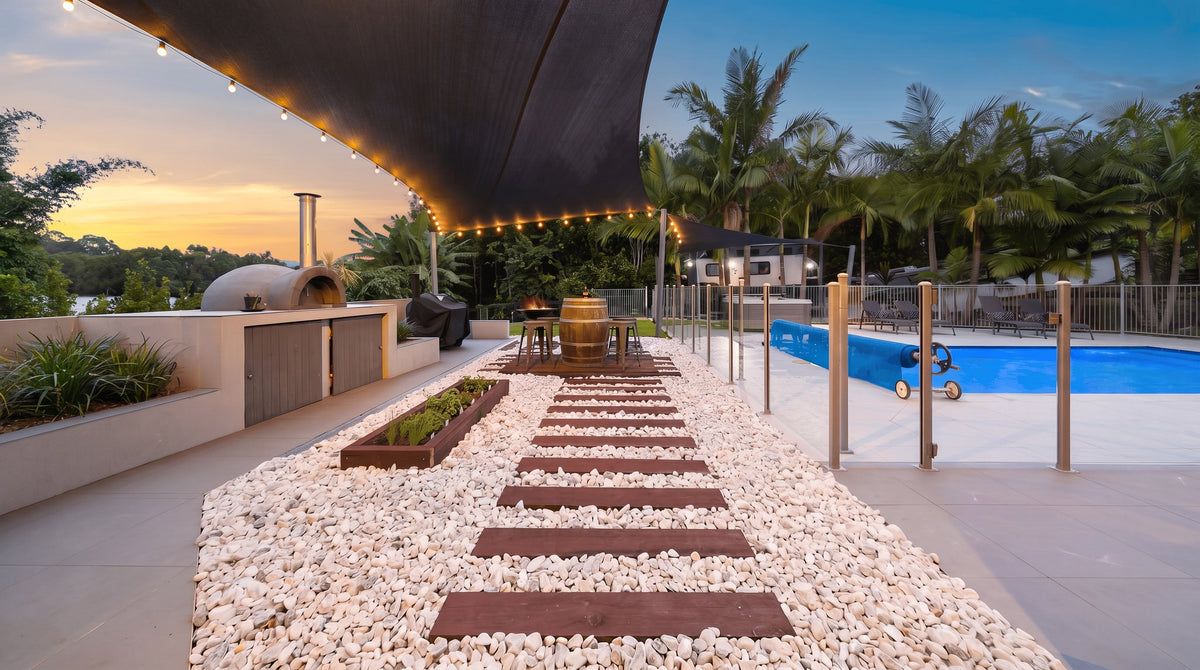
Outdoor string lights are an easy way to make a patio, deck, pool area, or backyard more inviting after dark. And if you already have a Shade Sail overhead, you can use its perimeter to create a neat run of lights around your outdoor space.
The important part is attaching them without drilling, cutting, or making permanent modifications to your Shade Sail. Making holes in the fabric or reinforced edges can damage the sail and may affect your warranty.
One of the simplest options is Shade Space’s Koru Clips. These small, removable clips slide onto the hem of your Shade Sail and provide a place to hold lightweight string lights underneath - no holes or permanent fixings required.
How Koru Clips Work
Koru Clips slide directly onto the existing hem of your Shade Sail. The long, flat section sits over the top of the hem, while the curved section underneath holds the string light cable.
Because they're removable, you can adjust the spacing, move your lights to another edge, or take everything down when it's no longer needed.
They're a simple option for permanent outdoor lighting, summer entertaining, parties, or adding a little extra light around a patio or deck.

How to Hang Outdoor String Lights Without Drilling
Before installing anything, work out where you want your lights to run.
Your string lights might not reach around the entire perimeter of your Shade Sail - and they don't necessarily need to.
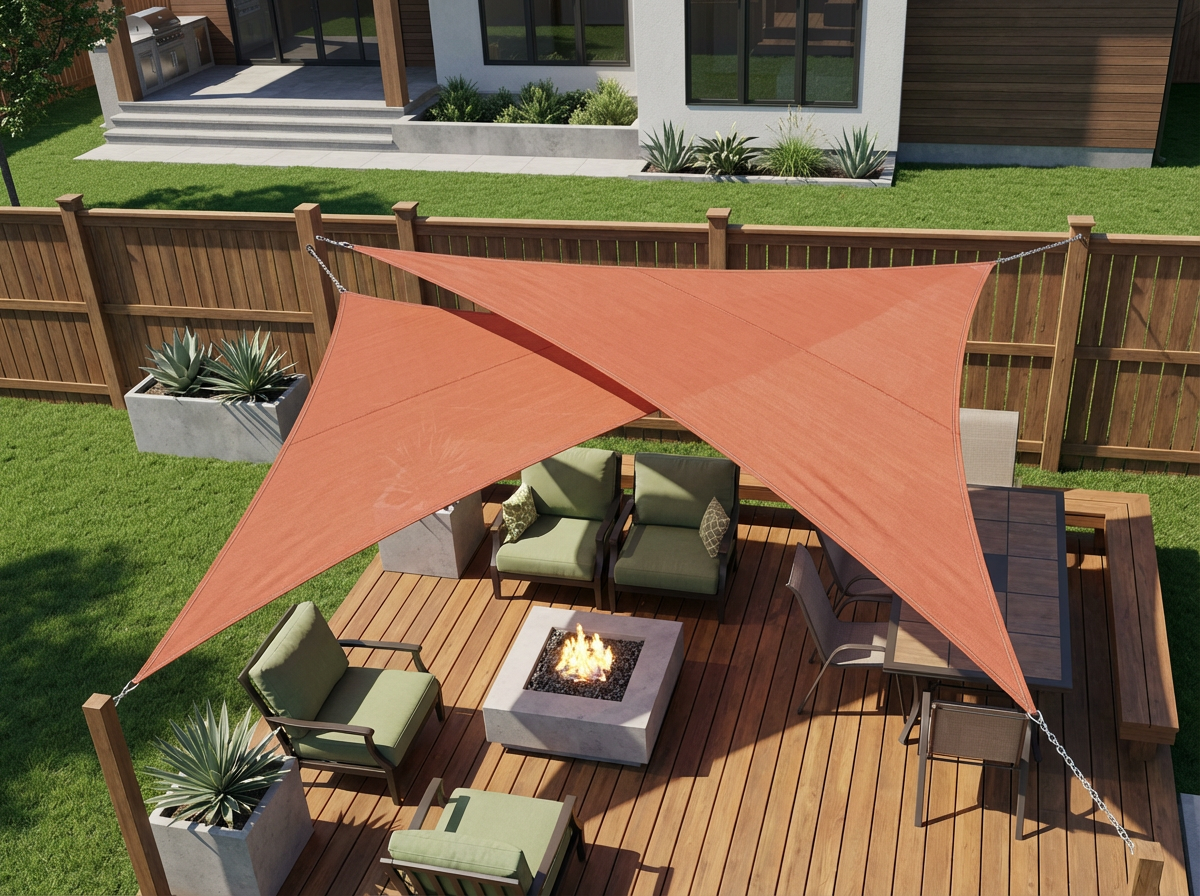
For example, on a triangular Shade Sail you might run lights along the two edges facing your entertaining area. On a rectangular sail, you could light one side, two sides, or the entire perimeter.
Lay your string lights out first to check the length and make sure the plug is positioned near your intended power source.
Once you're happy with the layout:
- Slide a Koru Clip over the hem of the Shade Sail with the curved section underneath.
- Place the string light cable into the curved section of the clip.
- Continue adding clips along the edge, adjusting the spacing as required.
- Check that the cable is supported without being pulled tight.
You want the lights to sit naturally between the clips. Avoid large unsupported sections that sag excessively, but don't tension the cable against the Shade Sail either.
How Many Koru Clips Do You Need?
The number of Koru Clips you'll need depends on the size of your Shade Sail, how much of its perimeter you're lighting, and the style and weight of your string lights.
Koru Clips are available in packs of 25. As a basic starting point:
- Small Shade Sails: around 1 pack / 25 clips
- Medium Shade Sails: around 2–3 packs / 50–75 clips
- Large Shade Sails: around 3+ packs / 75+ clips
These are only a guide. If you're lighting one edge of a Shade Sail, you'll need fewer than someone running lights around the entire perimeter.
The goal is simply to use enough clips to keep the cable neatly supported.
A Few Things to Check Before Adding Your Lights
Stick with lightweight string lights. A Shade Sail shouldn't be used to support heavy lanterns, pendant lights, heaters, speakers, or other substantial fixtures. These need their own suitable structural support.
It's also a good idea to choose string lights and electrical components designed for outdoor use. Check the lights, plugs, transformers, and extension leads, and follow the manufacturer's instructions for protecting electrical connections from the weather.
Remember that a standard HDPE Shade Sail isn't a waterproof roof. Rain can pass through the fabric, so don't assume electrical components underneath the sail will stay dry.
Finally, check the condition and tension of your Shade Sail. A correctly installed sail should be firm and well tensioned rather than loose or sagging. Wind load, fixing strength, post height, sail size, shape, hardware, and tension should all have been considered as part of the original installation.
If your Shade Sail is loose or the fixing points are questionable, you will need to deal with those issues before adding accessories.

Light Up Your Shade Sail Without Making Holes
If you're looking for how to hang outdoor string lights on a Shade Sail, there's no need to poke holes through the fabric or install permanent attachments.
Koru Clips simply slide onto the existing hem, making it easy to add lightweight string lights around as much - or as little - of your Shade Sail as you like.
When you want to change the layout or take the lights down, simply remove or reposition the clips.




Share:
What is a Hypar Shade Sail?